
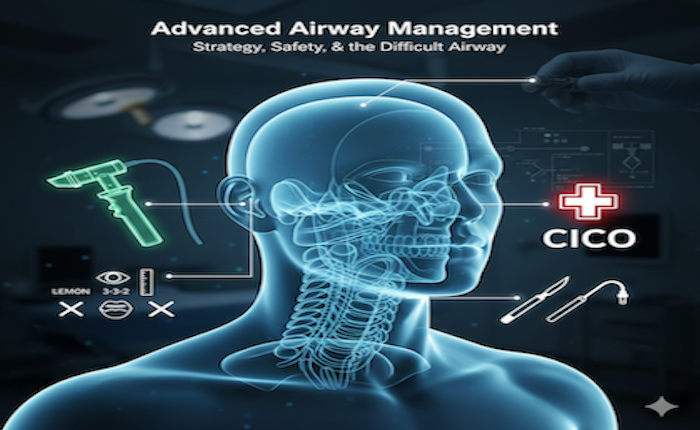
Advanced Airway Management: Strategy, Safety, and the Difficult Airway

Categories: Anesthesia
Wishlist Share
Share Course
Page Link
Share On Social Media

About Course

This course, provides an intensive, evidence-based review of airway safety and management, focusing on the difficult airway. Drawing on Level I evidence (e.g., 2022 ASA Guidelines, DAS protocols) and applied physiology, the curriculum moves providers from foundational knowledge to expert crisis resource management.

Key Domains Covered:

  • Basic: Applied anatomy (Three Axes, Sniffing Position), physiological reserves, and validated pre-operative risk stratification (LEMON).

  • Intermediate: Strategic application of the ASA Difficult Airway Algorithm (Awake vs. Asleep management), optimizing oxygenation (Apneic Oxygenation), and comparative efficacy of Video vs. Direct Laryngoscopy.

  • Expert: Management of the Can’t Intubate, Can’t Oxygenate (CICO) crisis, mastery of emergency Front of Neck Access (eFONA) (Scalpel-Bougie-Tube technique), and advanced strategies for extubation of the known difficult airway.


Show More

What Will You Learn?

  • This course on Advanced Airway Management covers the foundational science, strategic algorithms, and crisis management techniques necessary for safe practice

Course Content

Advanced Airway Management: From Assessment to CICO
Upon successful completion of this course, the anesthesia provider will be able to:

  • Learning Objectives

Module I: The Physiological & Anatomical Basis

Module II: Strategy & Algorithms

Module III: Crisis Management & CICO

End-of-Course Summary: Key Knowledge Tasks for the Anesthesia Provider
This course on Advanced Airway Management covered the foundational science, strategic algorithms, and crisis management techniques necessary for safe practice. As a result of this training, you should now possess the following key knowledge tasks:

Comprehensive Quiz
Instructions: Select the best answer.

References
Apfelbaum, J. L., et al. (2022). "American Society of Anesthesiologists Practice Guidelines for Management of the Difficult Airway." Anesthesiology, 136(1), 31-81. (Level I Evidence - Clinical Guidelines). Frerk, C., et al. (2015). "Difficult Airway Society 2015 guidelines for management of unanticipated difficult intubation in adults." British Journal of Anaesthesia, 115(6), 827-848. Lewis, S. R., et al. (2016). "Videolaryngoscopy versus direct laryngoscopy for adult patients requiring tracheal intubation." Cochrane Database of Systematic Reviews. Cook, T. M., et al. (2011). "Fourth National Audit Project. Major complications of airway management in the UK: Report and findings." Royal College of Anaesthetists. Higgs, A., et al. (2012). "Guidelines for the management of tracheal extubation." Anaesthesia, 67(3), 318-340.

Student Ratings & Reviews

No Review Yet
No Review Yet

Want to receive push notifications for all major on-site activities?